Yichen Tao
Friday, May 9, 2025
Influence of Rainfall Spatiotemporal Variability on Adverse Multiphase Flow Interactions in Dendritic and Looped Urban Drainage Networks
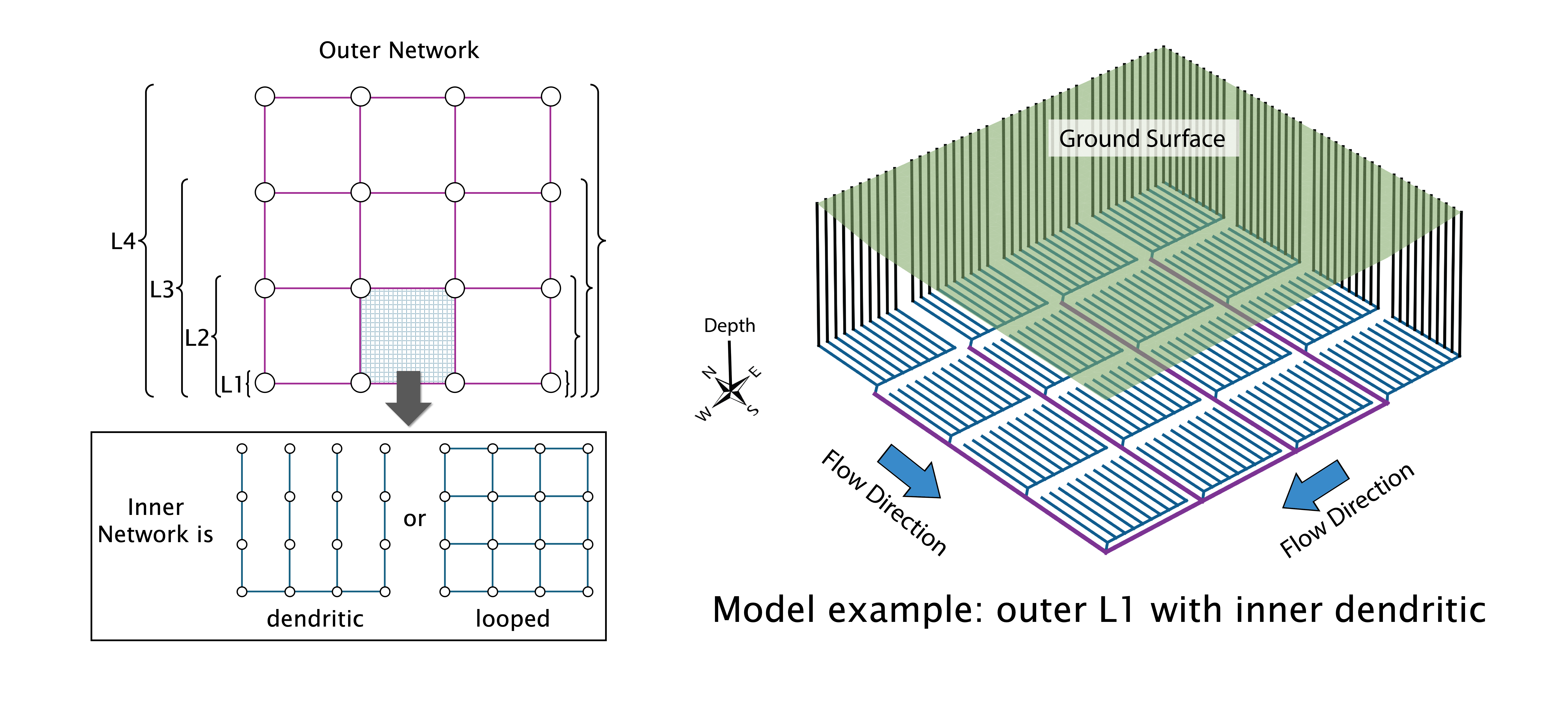
The operation of urban drainage has been challenged by aging stormwater collection networks (SCNs) and the impacts of climate change on the frequency and intensity of extreme rainfall. In extreme rainfall events, Adverse Multiphase Flow Interactions (AMFI) such as sewer geysering and displacement of manhole covers due to air entrapment effects have been observed in many cities. Current stormwater modeling and design practices do not adequately consider the processes leading up to AMFI. For example, commonly-used synthetic design storms fail to represent realistic rainfall variability, which has been shown to be a driver of pipeline pressurization, a prerequisite of AMFI occurrence. Other recent research has highlighted the importance of SCN topology on flow pressurization considering uniform rainfall intensities. However, the mitigation of AMFI conditions in large-scale networks necessitates the consideration of spatially and temporally variable rainfall, which is poorly understood. In this study, we designed eight idealized large-scale drainage networks with different SCN topologies, ranging from dendritic—i.e., with relatively few connections between system elements—to looped with many connections. High-resolution gridded radar rainfall datasets from several U.S. cities are used as inputs to network simulations using the Storm Water Management Model to obtain pressurization and air entrapment conditions. We hypothesize that analyzing the responses of different topological structures to rainfall spatiotemporal variability can help identify drainage network configurations that will be more reliable and robust in the face of increasingly extreme rainfall conditions.
Model diagram
Preliminary results
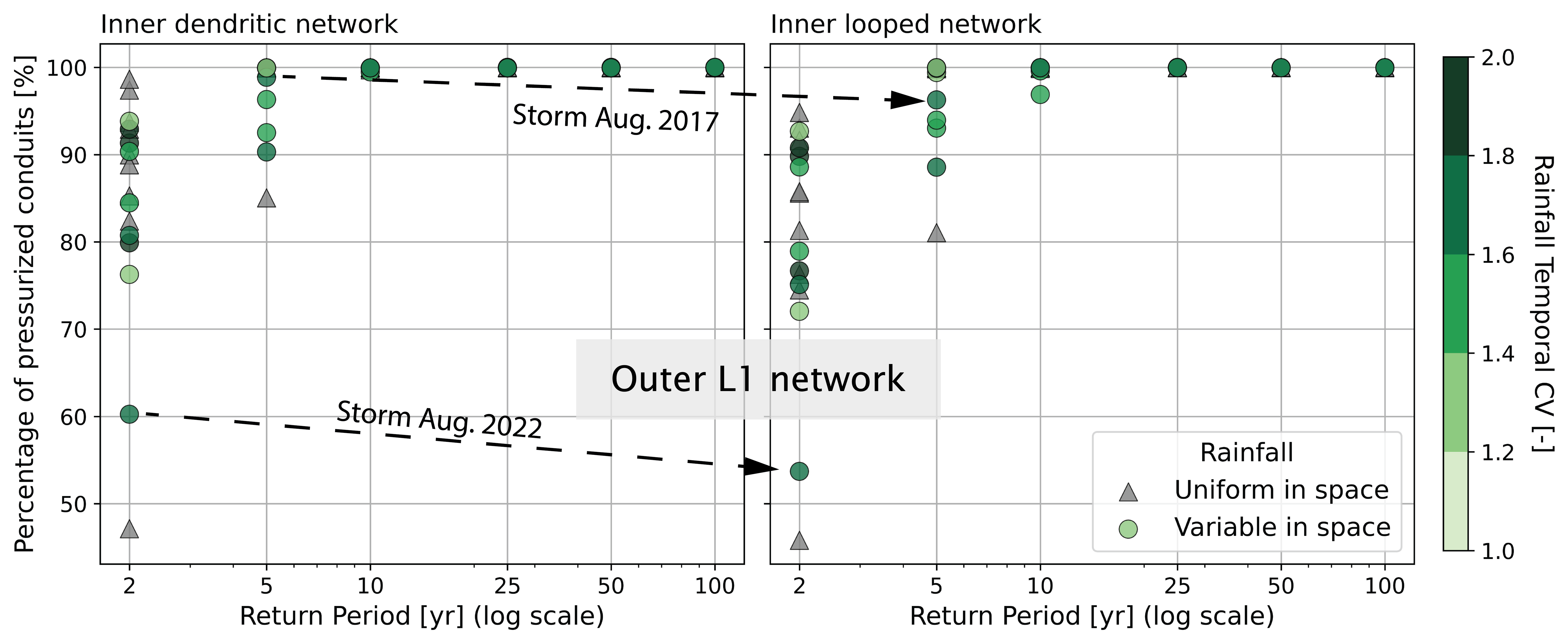
- Simulations with higher rainfall return periods show more occurrences of pipe pressurization.
- Looped networks trend to cause fewer pressurization occurrences.
- Temporal variability of storms affects the possibility of pressurization at low return periods.